The Oberammergau Passion Play has been performed by the villagers of a single Bavarian community since 1634, following a vow made during an outbreak of plague. It is not a festival the village decided to host. It is the fulfilment of a promise, renewed by each generation, and that distinction explains almost everything about how it works.
The plague and the vow
In the early 1630s the Thirty Years’ War moved armies, and disease, across Bavaria. When plague reached Oberammergau, the village council pledged that if the community were spared further deaths, its people would perform the story of the Passion, Death and Resurrection of Christ once every ten years. According to the village chronicle, no further plague deaths followed.
The first performance took place in 1634, staged in the churchyard among the graves of those who had died. The play has been performed in almost every decade since.
From churchyard to theatre
For its first two centuries the play moved between locations in and around the village as audiences grew. What began as a local act of devotion gradually attracted visitors from further afield, and by the nineteenth century the scale had outgrown any improvised setting.
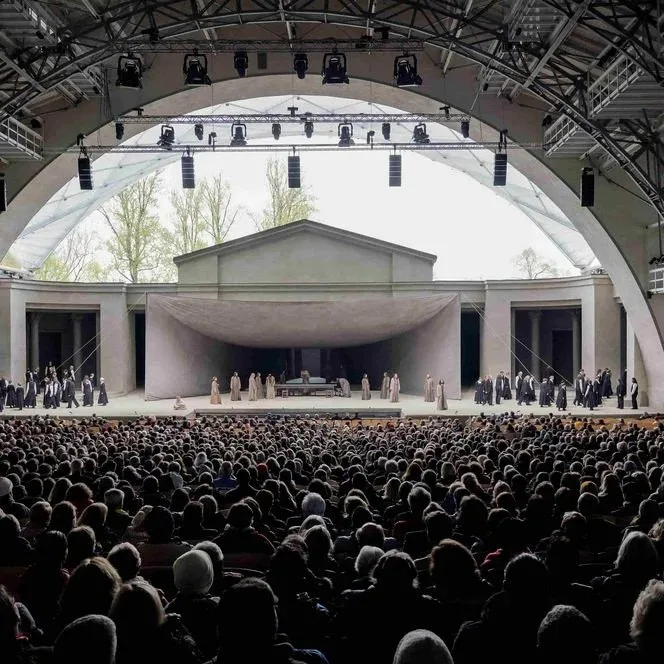
A succession of purpose-built stages followed, each larger than the last, culminating in the open-stage theatre that stands today: the auditorium roofed, the stage itself open to the sky, with the Alps behind it as part of the staging rather than a backdrop painted to imitate them.
Interruptions and the shape of the cycle
The decade rhythm has held remarkably well, but not perfectly. War and its aftermath disrupted the schedule more than once in the twentieth century, and the 2020 season was postponed to 2022. Each interruption was followed by a return to the cycle rather than an abandonment of it — which is itself part of the story the village tells about the vow.
The postponement of 2020 is the most recent illustration. The play was not cancelled; it was moved, and the cast that had prepared for 2020 performed two years later.
Reform after 1970
The text performed today is not the text of 1634. The most significant changes came from the 1970s onward, when the script and staging were revised in response to serious criticism of how the play portrayed Jewish figures and the events of the Passion.
Those revisions were substantial and continued across subsequent productions, developed in consultation with Jewish and Christian scholars. Groups planning a visit — particularly interfaith or educational groups — often want to know this history, and it is better addressed openly than discovered afterwards.
The modern productions
The productions of 2000, 2010 and 2022 each carried the revisions further and reworked the staging. Direction has shaped the modern era considerably: pacing, the treatment of the tableaux vivants, the role of the chorus and the visual language have all evolved, while the underlying structure — two parts separated by a long interval — has stayed constant.
What has not changed is who performs. Every role on stage, and every place in the choir and orchestra, is filled by a resident of Oberammergau.
Who is allowed to perform
The eligibility rule is strict: performers must have been born in the village or have lived there for a set number of years. Around two thousand villagers take part, which for a community of roughly five thousand means the play is less something the village hosts than something it becomes.
The most visible sign is the hair and beard decree. From Ash Wednesday of the year before a season, participants stop cutting their hair and beards, so that appearances are grown rather than applied. For 2030 that moment falls in early 2029, and it is when the village visibly turns towards the play.
Cultural heritage recognition
The Passion Play is recognised as intangible cultural heritage — a status that protects a living practice rather than a building or an object. What is recognised is the transmission of the tradition from one generation to the next and the participation of the whole community in it.
A common mix-up
Intangible cultural heritage is not the same as a UNESCO World Heritage Site. The Passion Play is not a World Heritage listing, and material describing it as one is inaccurate — worth knowing if you are writing client-facing copy.
Why the ten-year cycle matters commercially
A decade between seasons has consequences that catch operators out. There is no soft launch and no second chance: a group that misses 2030 waits until 2040. Capacity is fixed by the theatre and cannot be expanded to meet demand. Allocations released to the trade are finite and taken up early by operators who have worked the event before.
Oberammergau therefore behaves less like a theatre booking and more like scarce, dated inventory — available long before it is needed, and gone long before the year itself arrives.
2030: the next season
The 2030 season continues the cycle. What has been confirmed publicly so far is the year; the detailed schedule sits with the Passion Play Office and reaches the travel trade before it reaches the general public. Dates available to us appear on the performance dates page.
Where to go next
For what the play is and how a performance day runs, see the Passion Play. For when inventory becomes available, see when tickets go on sale. For what a trip costs, see ticket prices and costs.